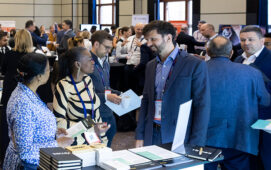
A-Team Group’s Intelligent Trading Summit got off to a great start last week with A-Team chief content officer Andrew Delaney enjoying a fireside chat with BNP Paribas head of electronic execution strategy Kee-Meng Tan. Delaney and Tan discussed the need for speed in electronic trading, the adoption of new technologies and opportunities to look beyond the financial services industry for inspiration. They also highlighted the drag on electronic trading caused by increasing regulation, particularly Markets in Financial Instruments Directive II (MiFID II).
On the need for speed, Tan noted the ongoing requirement to be among the fastest to get to market and execute trades, but also the need for better algos and trading models. He explained: “The industry is working on better technology and models, but speed is still important. Firms are squeezing the last microseconds out of connectivity and supporting speed with technologies such as field programmable gate arrays and microwave networks.”
Tan encouraged delegates to look at technologies used by industries that are technologically ahead of financial services, such as the mobile phone industry, and promoted the value of working with academia to incorporate academic research into electronic trading technology. He also recommended outsourcing areas of regulatory compliance that are expensive to support, but don’t make money for the firm.
Regulation was, perhaps, the hottest topic in Delaney and Tan’s fireside chat, and an issue that came up frequently throughout the conference. Tan talked about the huge complexity faced by banks that must comply with regulations including MiFID II, Dodd-Frank and European Market Infrastructure Regulation, and the difficulty in balancing investment between technology to build business and regtech.
Focussing on MiFID II, he noted the extent of the regulation, yet uncertainty around final technical standards, and raised concerns about a lack of market understanding among politicians intent on shoehorning non-equity products such as fixed income into initial MiFID regulation designed to cover only equity products. While politicians lay down the law with good intentions, Tan noted that it is then the responsibility of regulators to interpret the law, which in some cases proves illogical and often leaves questions unanswered.
Taking a step away from specific issues such as MiFID II, the complexity of compliance, budgetary constraints and new technologies, Tan provided advice to conference delegates, saying: “Consider what business you are really in and outsource commoditised functions as much as possible. Then concentrate your intelligence on technologies and models that will benefit your firm and your clients.”
The A-Team Intelligent Trading Summit in London – which will be followed by a similar summit event in New York City in May – went on to present a number of panels and keynotes covering everything from the challenges of regulatory compliance to best practice for optimal electronic execution, high performance technologies for fast analytics, the convergence of no-touch and low-touch trading technology stacks, machine learning and fintech firms emerging in the intelligent trading technologies market.
Subscribe to our newsletter