

Market & Alt Data Insight Corporate, Supply Chain & B2B Data The latest content from across the platform

Why Agentic AI Is Shifting Attention Back to the Data Layer
The rapid improvement of large language models is changing the way financial institutions approach agentic AI. Model capability remains important, alongside the practical challenges of connecting AI to the right data, providing sufficient context, embedding agents into investment workflows and controlling what they can access and do. These issues featured prominently during a panel discussion…

Can Alternative Data Close the Credit Risk Visibility Gap?
Credit risk has traditionally been monitored through a familiar collection of fundamentals, ratings and market prices. But as private and public credit markets become more interconnected, investors are looking across a much wider range of data for signs that a borrower – or an entire sector – may be running into trouble. That search for…

As AI Lowers the Bar for Alternative Data, Where Does the Edge Move Next?
Alternative data has spent much of the past decade moving from the margins of investment research towards the mainstream. Now, artificial intelligence is accelerating that process, making datasets easier to discover, evaluate, process and combine while allowing investment teams to tackle sources that would previously have required considerable engineering resources. But that creates a new…

Beyond the API: FactSet on Making Financial Data Ready for Agentic AI
The effectiveness of an AI agent ultimately depends on the quality, context and structure of the information it can access. For investment firms, that puts familiar challenges around data quality, provenance and integration firmly back on the agenda – while potentially changing what they expect from their data providers. “When you’re selling data, you’re not…
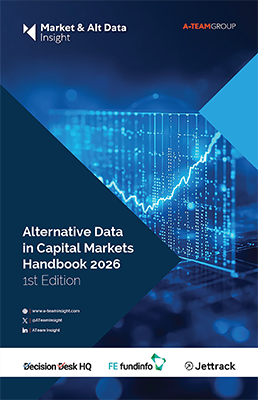
Alternative Data in Capital Markets Handbook 2026
Alternative data adoption in capital markets has moved into a more disciplined phase. Simply possessing a dataset is no longer a differentiator – the priority now is how data is sourced, synthesised and deployed, and how quickly granular, disaggregated signals can be turned into validated, decision-ready insight. The 2026 edition of the Alternative Data in…

What a $3bn YipitData Valuation Says About the Value of Alternative Data
Carlyle-backed YipitData is reportedly exploring a sale that could value the alternative data and analytics provider at between $2.5 billion and $3 billion, offering a useful indication of how investors are valuing proprietary data assets as artificial intelligence reshapes the information industry. The prospective sale comes as the rapid development of AI is prompting investors…

What is the Value of a Failed Company’s Data in the AI Era?
When an airline goes bankrupt, there are some fairly obvious assets to be sold: aircraft, airport slots, equipment, intellectual property and perhaps its brand. But the bankruptcy of Spirit Airlines has highlighted another potentially valuable asset – the accumulated data exhaust of the enterprise itself. Google recently won an auction to acquire a substantial collection…

Rethinking Alternative Data Infrastructure with Aerospike
Investment firms have never had access to more data. From corporate filings and social media to satellite imagery, transaction data and other alternative sources, the range of information that can potentially feed the investment process continues to expand. But as AI becomes embedded more deeply into research and investment workflows, the challenge is shifting. Simply…

How EventVestor Puts Alternative Data in Context
For investment firms looking to extract signals from alternative data, finding an interesting dataset is only part of the challenge. Moving that data from research into production brings a different set of requirements around quality, timeliness, consistency and historical accuracy. Those requirements are particularly important for quantitative investment firms, where apparently small discrepancies in timestamps,…

Kadoa and the New Economics of Web Data
For investment firms seeking an informational edge, the web represents an extraordinarily rich source of potential data. Product inventories and pricing, corporate activity, technology adoption, infrastructure development and countless other indicators can all provide insights that may not be available through conventional market and financial data sources. Extracting that information reliably, however, has traditionally required…