

Market & Alt Data Insight Geospatial, Commodities & Physical-World Data The latest content from across the platform

Why Agentic AI Is Shifting Attention Back to the Data Layer
The rapid improvement of large language models is changing the way financial institutions approach agentic AI. Model capability remains important, alongside the practical challenges of connecting AI to the right data, providing sufficient context, embedding agents into investment workflows and controlling what they can access and do. These issues featured prominently during a panel discussion…

As AI Lowers the Bar for Alternative Data, Where Does the Edge Move Next?
Alternative data has spent much of the past decade moving from the margins of investment research towards the mainstream. Now, artificial intelligence is accelerating that process, making datasets easier to discover, evaluate, process and combine while allowing investment teams to tackle sources that would previously have required considerable engineering resources. But that creates a new…
Beyond the API: FactSet on Making Financial Data Ready for Agentic AI
The effectiveness of an AI agent ultimately depends on the quality, context and structure of the information it can access. For investment firms, that puts familiar challenges around data quality, provenance and integration firmly back on the agenda – while potentially changing what they expect from their data providers. “When you’re selling data, you’re not…
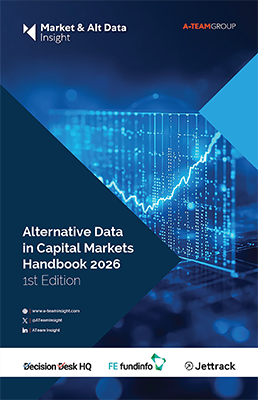
Alternative Data in Capital Markets Handbook 2026
Alternative data adoption in capital markets has moved into a more disciplined phase. Simply possessing a dataset is no longer a differentiator – the priority now is how data is sourced, synthesised and deployed, and how quickly granular, disaggregated signals can be turned into validated, decision-ready insight. The 2026 edition of the Alternative Data in…

Rethinking Alternative Data Infrastructure with Aerospike
Investment firms have never had access to more data. From corporate filings and social media to satellite imagery, transaction data and other alternative sources, the range of information that can potentially feed the investment process continues to expand. But as AI becomes embedded more deeply into research and investment workflows, the challenge is shifting. Simply…

Multiplying the Value of Unstructured Data
Financial institutions have spent years expanding the range of data available to investment, trading and risk teams. Increasingly, however, the challenge is not obtaining more data but making sense of what they already have. Unstructured data is estimated to account for 80-90% of the information generated withinfinancial institutions, encompassing everything from regulatory filings and earnings-call…

A-Team Group Announces Capital Markets Technology APAC Awards 2026 Winners and Launches ‘State of the Market’ Report
A-Team Group today announced the highly anticipated winners of the Capital Markets Technology APAC Awards 2026. These prestigious awards celebrate the most innovative solution providers and financial institutions that are reshaping the capital markets technology landscape across the dynamic Asia Pacific region. In conjunction with the awards, A-Team Group has also launched the “State of…

How Much Hedge Fund Alpha Is Lost Before the Model Even Runs?
How often is a hedge fund’s apparent model failure actually a data failure in disguise? A model that stops working. A backtest that does not replicate. A risk number that needs explaining. How to tell one from the other – before reaching for the model first – was the recurring question of an hour-long discussion…

Are Firms Hunting Alpha Outside While Deleting It at Home?
A trading firm will pay for 15 years of price history from a market data vendor and, on a parallel housekeeping schedule, purge its own order flow, client activity and system logs after five to seven. The vendor history is treated as an asset worth a recurring licence fee. The firm’s own data – generated…

Is the Real Value of Intraday Alternative Data in Risk, Not Alpha?
Intraday alternative data has long been the preserve of high-frequency and systematic desks, where speed provides an edge. But ask practitioners what decision it actually changes for a discretionary book, and the answer is rarely about generating a new trade, it is more about testing the one already on. Sizing, conviction and the risk sitting…