

Market & Alt Data Insight Market Data, Feeds & Trading Signals The latest content from across the platform

Databento and the Consumerisation of Market Data
Institutional market data has long been associated with complex licensing, specialist infrastructure and lengthy procurement processes. Much of that complexity is unavoidable: exchange data can be technically demanding, commercially restricted and costly to distribute at scale. However, the expectation around how that data should be accessed is changing. As financial firms become more accustomed to…
Alternative Data in Capital Markets Handbook 2026
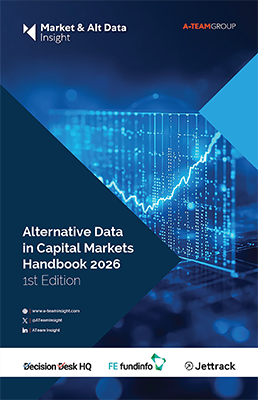
Alternative data adoption in capital markets has moved into a more disciplined phase. Simply possessing a dataset is no longer a differentiator – the priority now is how data is sourced, synthesised and deployed, and how quickly granular, disaggregated signals can be turned into validated, decision-ready insight. The 2026 edition of the Alternative Data in…

Rethinking Alternative Data Infrastructure with Aerospike
Investment firms have never had access to more data. From corporate filings and social media to satellite imagery, transaction data and other alternative sources, the range of information that can potentially feed the investment process continues to expand. But as AI becomes embedded more deeply into research and investment workflows, the challenge is shifting. Simply…

Bond Market Stress Starts at the Top, But the Real Challenge Lies Further Down
By Kevin Rutter, CEO, AIQ Markets. As any bond trader will tell you, when stress occurs in investment grade, it’s time to take notice. The New York Fed recently flagged a sharp increase in high-grade trading dysfunction during July. The CDMI Index, a weekly composite measure that represents the health and functioning of primary and…
ADX Launches First MENA Integration of Live Market Data into Conversational AI Platforms
The Abu Dhabi Securities Exchange (ADX) has become the first stock exchange in the MENA region to provide direct access to official live market data through conversational artificial intelligence platforms, including ChatGPT and Claude. Delivered via a governed Model Context Protocol (MCP) server, the framework enables investors, developers, and institutions to query exchange data using…
S&P Global Expands Collaboration with Microsoft to Integrate AI Data into Microsoft 365 Copilot
S&P Global has announced an expanded collaboration with Microsoft to integrate its AI-ready data, analytics, and insights directly into Microsoft 365 Copilot workflows and agentic tools. Powered by the S&P Global AI Data Portal’s Deterministic Retrieval solution – also known as the Kensho LLM-ready API – the system enables users to access verifiable and cited…
Exegy to Distribute EuroCTP’s Real-Time Shares and ETF Feed
Exegy will distribute EuroCTP’s real-time multicast FIX SBE feed, the EU’s first real-time pre- and post-trade Consolidated Tape for shares and ETFs, when it goes live on September 14th. Building on a technology partnership established in 2024, Exegy will serve as a redistribution partner for the feed. This includes the European Best Bid and Offer…

FutureSports and CME Look to Turn Sports Performance into a Tradable Asset Class
Professional sports could be about to acquire a new dimension as a financial asset class, with CME Group preparing to launch the first exchange-traded futures contracts based on the performance of National Hockey League (NHL) teams. The derivatives exchange plans to launch standard and micro-sized Hockey futures on September 28, pending regulatory review. The contracts…

S&P Global QnA: Adaptive Retrieval Smooths Data Access and Use
S&P Global Market Intelligence launched Adaptive Retrieval last month, promising to give clients greater flexibility in accessing and using the ratings giant’s data via their large language models (LLMs) and agents. Complementing S&P Global’s existing Deterministic Retrieval tool, which is built on the Kensho LLM-ready API, the latest innovation enables users to query and make…

Multiplying the Value of Unstructured Data
Financial institutions have spent years expanding the range of data available to investment, trading and risk teams. Increasingly, however, the challenge is not obtaining more data but making sense of what they already have. Unstructured data is estimated to account for 80-90% of the information generated withinfinancial institutions, encompassing everything from regulatory filings and earnings-call…