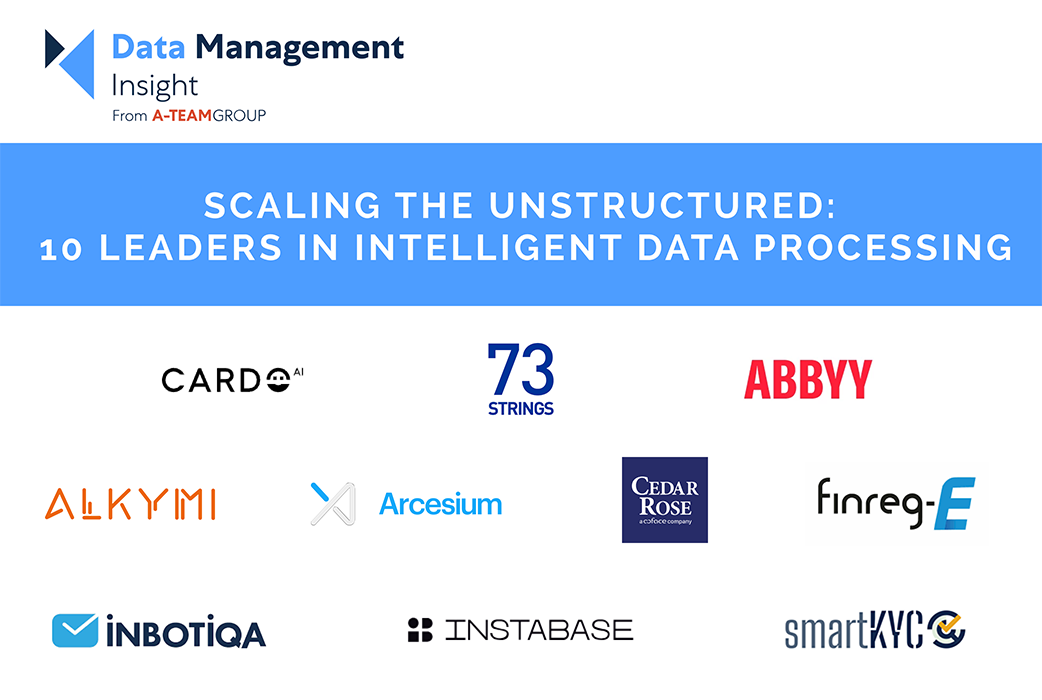
Huge swaths of critical financial information, from private credit agreements and ESG disclosures to complex tax documentation, is locked in unstructured formats such as digital documents and PDFs. The manual bottleneck this creates for the middle and back office eats into valuable resources. A key means to achieving this, Intelligent Data Processing (IDP), represent a pragmatic shift from simple optical character recognition to sophisticated, context-aware AI. This article profiles the leading vendors addressing these challenges, offering solutions that bridge the gap between raw documents and actionable institutional intelligence.
Winner, Data Management Insight Awards – Europe: Best Data Management Solution for Unstructured Data, 2025
Cardo AI provides an integrated platform designed to manage the full lifecycle of private market investments. Its platform is tailored for the structured finance and private credit ecosystems, using proprietary algorithms to map complex, non-standardised loan-level data into a unified relational model. It is built to eliminate the fragmentation inherent in private debt markets, allowing institutional investors and lenders to automate the monitoring of diverse portfolios that previously required massive manual reconciliation efforts.
The specialised extraction engine, 73 Extract, is focused on the alternative assets sector, including private equity and real estate. It is purpose-built for the nuances of capital call notices, distribution notices and quarterly reports, featuring AI models trained on the templates common to the GP-LP relationship. It seeks to solve the valuation lag by accelerating the time it takes to ingest portfolio company data, ensuring that middle-office teams can update internal benchmarks in hours rather than weeks.
ABBYY’s Vantage offering is a low-code IDP platform that applies AI to understand and process high-volume corporate documentation. Its skill-based architecture enables firms to download pre-trained AI models from a marketplace to manage specific document types. In so doing, it seeks to addresses the scalability issue for global financial institutions, transforming a centralised, rigid OCR process into a flexible, distributed capability that can be deployed across various business lines simultaneously.
Among its offerings, Alkymi automatically captures, extracts and transforms data from emails and documents into ready-to-use digital formats, with a heavy focus on a human-in-the-loop (HITL) interface that allows subject matter experts to quickly validate AI-extracted data. It is designed to end the reliance on copy-paste workflows, ensuring that unstructured data arriving via email is structured and integrated into downstream systems without manual intervention.
Arcesium provides data management and enterprise investment operations platforms with IDP capabilities that are integrated into a broader investment data management (IDM) framework that emphasises data lineage and quality. By unifying unstructured data extraction with its core data platform, Arcesium seeks to eliminate data silos.The automated collection and processing of corporate intelligence and credit risk data, particularly in emerging markets is achieved by processing and translating data from complex jurisdictions and non-Latin scripts, which is often a blind spot for Western-centric IDP tools. This removes the manual burden of international due diligence and know your business (KYB) checks, allowing compliance teams to obtain structured risk scores from unstructured foreign registry filings instantly.
FinregE provides an AI-driven regulatory compliance platform that automates the processing of global regulatory updates and internal policy documents. its platform uses natural language processing (NLP) specifically tuned for legalese, allowing it to map regulatory changes directly to a firm’s specific internal controls and obligations. This helps compliance departments that are struggling to manually read and interpret thousands of pages of new rules to determine what is relevant to their specific business model.
Inbotiqa’s enterprise-grade platform YUDO is designed to manage and automate high-volume email and document workflows in back-office operations by categorising and routing unstructured communications to the correct team while tracking resolution metrics. This addresses the lack of transparency and auditability in shared mailboxes, preventing lost instructions and ensuring that urgent operational tasks trapped in emails are prioritised and executed.
Instabase’s horizontal application platform enables firms to build custom automated workflows for complex document processing. The building block approach enables developers to combine disparate technologies — such as LLMs, specialised OCR, and logic engines — to solve unique, multi-step document challenges.
SmartKYC automates the multi-lingual KYC screening process by extracting risk-relevant information from news and web sources. It is focused on entity resolution, ensuring that the AI distinguishes between individuals with similar names and correctly identifies the ultimate beneficial owner from unstructured registries. It aims to end the high rate of false positives that plague traditional screening tools, allowing KYC analysts to focus only on high-risk relationships rather than manually filtering through irrelevant news hits.
Subscribe to our newsletter