The friction inherent in mobilising data is a perennial problem for financial institutions, who have spent the last decade perfecting the passive data stack – investing heavily in cloud warehouses, governance frameworks and ETL pipelines designed to move data for human consumption. However, the operational reality remains plagued by manual intervention.
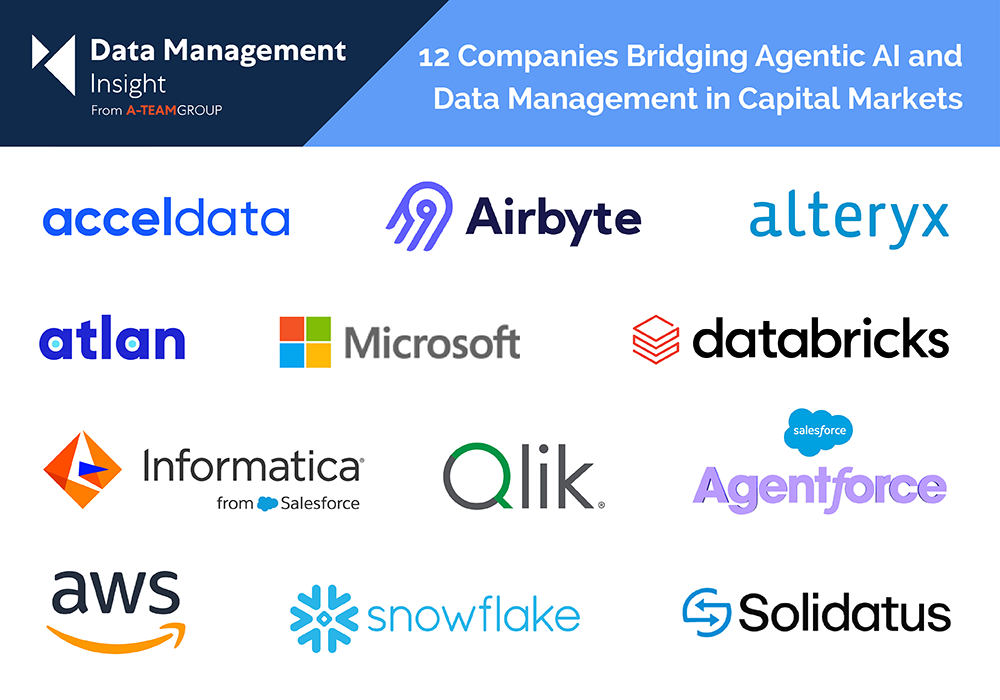
Recent developments in agentic artificial intelligence (AI) are fundamentally altering this dynamic. Here, Data Management Insight profiles 12 leading vendors who are providing the infrastructure and orchestration layers necessary to harness agentic AI.Acceldata provides an enterprise-grade data observability and agentic data management platform that monitors and self-heals data pipelines. Its xLake Reasoning Engine utilises specialised AI agents to autonomously detect, analyse, and remediate schema drift and data quality issues across hybrid and multi-cloud environments. It eliminates data downtime in high-frequency environments, ensuring that downstream AI models and trading algorithms are never fed corrupted or stale information.
This open-source data integration platform synchronises data from applications, APIs, and databases to warehouses and lakes. The Agentic Connector Framework allows AI models to interact with data sources in real-time, effectively giving agents read-and-write permissions across 300-plus disparate data silos. This approach eliminates the manual maintenance of custom data pipelines, ensuring that autonomous agents have a consistent, high-fidelity stream of fresh data for decision-making.
Alteryx provides an automated analytics platform designed to democratise data engineering and spatial analytics across the enterprise. Its Alteryx AiDIN engine integrates agentic AI directly into low-code workflows, allowing non-technical users to build agents that can prep, blend and analyse data automatically. This is designed to reduce the dependency on specialised data science teams, enabling business units to automate complex reporting and analytical tasks that previously required manual spreadsheet manipulation.
This active metadata management and data governance platform serves as a collaboration layer for data teams and utilises agentic governance to automatically document metadata, assign ownership and flag data quality issues as they arise in a process of self-healing the data catalogue. Dark data and poor data quality are addressed in this way, ensuring that AI agents are not making decisions based on inaccurate, stale or non-compliant information.
AWS (Amazon Bedrock & Amazon Q)
AWS’ suite of cloud-native AI tools includes Bedrock for foundation model orchestration and Amazon Q for generative assistance. The agents for Amazon Bedrock feature allows developers to create agents that can automatically execute API calls to other AWS services or third-party enterprise systems. AWS provides the scalable, secure infrastructure needed to move agentic AI from experimental sandboxes into full-scale production environments without leaving the cloud.Databricks, a unified data and AI company that pioneered the lakehouse architecture, offers its Unity Catalogue to provide a single governance layer for both data and AI assets, enabling agents to securely access structured and unstructured data while maintaining strict lineage. It breaks down the silos between data engineering and machine learning, providing a unified foundation where agents can search across the entire enterprise data footprint via vector embeddings.
The Intelligent Data Management Cloud (IDMC) offers a suite of services for data integration, quality and master data management, incorporating the CLAIRE GPT engine, which uses metadata-driven AI to automate the discovery and classification of data assets. This enables autonomous data management across multi-cloud environments and mitigates the complexity of managing data across hybrid and multi-cloud architectures, providing a single source of truth that is essential for agentic reliability.
The venerable software giant provides a holistic data and AI ecosystem, integrating Azure OpenAI Service with Microsoft Fabric, a unified analytics platform to provide deep integration with Office 365 and Power Platform. This allows agents to operate across the entire productivity suite, turning data insights into automated emails, reports or alerts. By addressing the fragmentation of professional workflows, this seeks to allow a seamless transition from back-office data analysis to front-office communication and action.
Qlik specialises in data integration, analytics and real-time data delivery for business intelligence. Its Staige framework focuses on active intelligence, where AI agents are triggered by real-time data changes – such as a market-price shift – to initiate downstream actions. This enables institutions to move away from reactive, dashboard-based reporting towards a proactive model where the data stack itself drives the next best action.
The customer relationship management (CRM) and enterprise cloud software giant’s Agentforce enables firms to deploy autonomous agents that are context-aware regarding client relationships, leveraging the data cloud to personalise interactions at scale. It automates high-touch client service and sales tasks in wealth management and institutional sales, ensuring that client data is leveraged instantly rather than languishing in a CRM.
The cloud-based data platform that enables data storage, processing and analytic solutions offers Cortex AI service that allows users to build agentic apps directly within the Snowflake security perimeter, utilising Cortex Search to feed agents’ high-relevance data without moving it. Cortex eliminates the security risks associated with moving sensitive financial data to external AI models, keeping the logic and the data in one governed environment.
The data lineage and metadata management specialist offers AI Lineage Assistant, which uses agentic AI to autonomously draft data mappings and enrich metadata from unstructured sources like PDFs and spreadsheets, while maintaining bi-temporal version control. This is designed to accelerate regulatory reporting and compliance by providing defensible, audit-ready evidence of data provenance that is fast to generate and update.
Subscribe to our newsletter