About a-team Marketing Services
The knowledge platform for the financial technology industry

A-Team Insight Blogs

SIs on the Rise Across Asset Classes

Subscribe to our newsletter

By: Christian Voigt, senior regulatory advisor, Fidessa

There’s been much speculation about the revival of the Systematic Internaliser (SI) as Markets in Financial Instruments Directive II (MiFID II) has sharpened its rules. So, now that we’re almost two months into the new regime, how is it looking?

Luckily the regulators (e.g. ESMA and FCA) publish registers of all their SIs, and the asset class they’re active in, telling us something about the evolving market structure. Even though ESMA’s list seems incomplete (where are the Swedish SIs, for example?), with the help of ISO 10383 you can reasonably close those gaps.
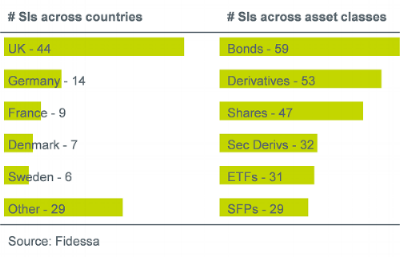
Currently, there are about 109 SIs in varying states of registration in Europe. Given that pre-MiFID II there were less than 20, that’s a considerable increase. In terms of distribution across countries, there are no real surprises with the usual suspects at the top. But, more interesting, is the distribution across asset classes. Designed with equities in mind, SIs appear to be conquering other asset classes too, with more of them active in bonds and derivatives. Who would have thought it?

Subscribe to our newsletter

Related content

WEBINAR

Recorded Webinar: Sponsored by FundGuard: NAV Resilience Under DORA, A Year of Lessons Learned

The EU’s Digital Operational Resilience Act (DORA) came into force a year ago, and is reshaping how asset managers, asset owners and fund service providers think about operational risk. While DORA’s focus is squarely on ICT resilience and third-party dependencies, its implications extend deep into core operational processes that are critical to market integrity, investor...

BLOG

Swap Data Was Supposed to Deliver Transparency. A Decade Later, Regulators Are Still Trying to Use It

For more than a decade, regulators have collected vast quantities of derivatives transaction data through swap data repositories (SDRs) mandated by post-crisis financial reforms. Yet despite the scale of these datasets, transforming reported trade data into meaningful supervisory insight has often proved more difficult than policymakers anticipated. A new Memorandum of Understanding (MOU) between the...

EVENT

RegTech Summit London

Now in its 9th year, the RegTech Summit in London will bring together the RegTech ecosystem to explore how the European capital markets financial industry can leverage technology to drive innovation, cut costs and support regulatory change.

GUIDE

AI in Capital Markets Handbook 2026

AI adoption in capital markets has moved into a more disciplined phase. The priority is now controlled deployment: where AI can be used safely, where it can deliver measurable value, and how outputs can be governed, monitored and evidenced. The 2026 edition of the AI in Capital Markets Handbook examines how AI is being applied...