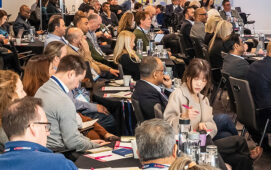
Sun Microsystems is running a “Trading Applications Developer Workshop” on Thursday, January 22nd, at its New York City customer briefing centre. The workshop – with an emphasis on latency – runs from 8.30am to 1pm, followed by lunch, and is free to qualified registrants. Click here to register. Attendance is limited so register today. IntelligentTradingTechnology.com spoke with Ian Pearl, Global Lead – Low Latency Trading & Market Data at Sun, to find out more about the workshop and what it will cover.
IntelligentTradingTechnology.com Why is there a need for a workshop like this?
Ian Pearl: A recent survey by Net2S identified that the majority of the end-to-end latency in firms’ electronic trading systems resides in the applications that are the algo engines; programs making the decisions about what and where to trade. In general, these applications are written by in-house developers rather than purchased off-the-shelf from application software vendors.
We feel that many of the developers of these applications would benefit from our experiences of how the latest tools, techniques, and technologies might help them to eliminate latency and jitter from their trading applications. In another report, Citihub highlighted the difference between ‘Operational Latency’, which is the delay on each trade as passes through the systems, and ‘Event-Driven Latency’, which is a catastrophic crash caused by an unusual event, such as a spike or a system failure.
The report highlighted the primary importance of building robust systems in order to address the latter condition, which is particularly tough given the need to write applications that have extraordinary performance and yet to deploy them live very quickly. We believe that customers are interested in hearing about technologies which might help them to achieve these often mutually exclusive ambitions.
ITT: What specific subject areas will be explored?
Ian: There will be a number of presentations from subject-matter experts from both Sun and Intel about how to maximise performance by making use of the latest multi-core, multi-thread processors by building highly parallelised applications.
There will also be discussion about how to scale by making many machines operate collaboratively using data grids and other techniques and architectures; clearly some technologies are more suited to a low latency environment than others and we will be addressing the characteristics of these.
There are, of course, applications which would benefit from being architected to scale-up rather than scale-out, and we will discuss what these might look like and in what environments they might perform best. We feel that Complex Event Processing is an area that is worth investigating because it can deliver highly performant applications in much reduced development timescales, and we will have a presentation from one of Sun’s CEP partners.
Finally we will be looking at the options for low latency data access. In the past, access to database might have been a source of latency, but we plan to introduce some new Sun technologies which will speed up access to data by an order of magnitude.
ITT: What specific Sun technologies will be highlighted?
Ian: Perhaps surprisingly we will not be spending much time discussing hardware. We will certainly be positioning Solaris as the only operating system which can deliver deterministic behaviour whilst continuing to perform reliably under extreme loads of update throughput. We will be discussing kernel scheduling options and how application performance can be impacted by tuning.
The bulk of the time will be dedicated to tools such as DTrace which allow you to reach into your applications and the OS to understand where latency is lurking, and to developer tools such as Real-Time Java and the Studio compilers – there will be special attention to how these tools have been optimised to take advantage of the features of the latest Intel processors.
ITT: Should non-Sun/Solaris developers attend?
Ian: Yes, of course. We are at the start of bringing together a community of developers and architects who are working in the trading applications area so that we can share ideas, approaches, etc, so this will be the first of many such workshops.
Whilst the bias of this event will undoubtedly be towards the benefits of Solaris, it is definitely intended to deliver content rather than being a sales pitch for Sun products. Consequently I would hope that anyone in this area of technology will benefit from attending.
Subscribe to our newsletter