About a-team Marketing Services
The knowledge platform for the financial technology industry

A-Team Insight Blogs

SIs on the Rise Across Asset Classes

Subscribe to our newsletter

By: Christian Voigt, senior regulatory advisor, Fidessa

There’s been much speculation about the revival of the Systematic Internaliser (SI) as Markets in Financial Instruments Directive II (MiFID II) has sharpened its rules. So, now that we’re almost two months into the new regime, how is it looking?

Luckily the regulators (e.g. ESMA and FCA) publish registers of all their SIs, and the asset class they’re active in, telling us something about the evolving market structure. Even though ESMA’s list seems incomplete (where are the Swedish SIs, for example?), with the help of ISO 10383 you can reasonably close those gaps.
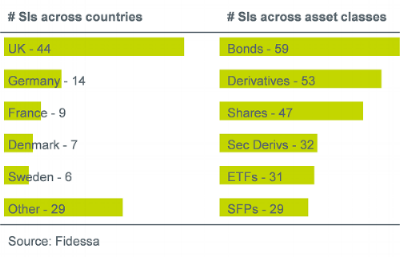
Currently, there are about 109 SIs in varying states of registration in Europe. Given that pre-MiFID II there were less than 20, that’s a considerable increase. In terms of distribution across countries, there are no real surprises with the usual suspects at the top. But, more interesting, is the distribution across asset classes. Designed with equities in mind, SIs appear to be conquering other asset classes too, with more of them active in bonds and derivatives. Who would have thought it?

Subscribe to our newsletter

Related content

WEBINAR

Recorded Webinar: Sponsored by FundGuard: NAV Resilience Under DORA, A Year of Lessons Learned

The EU’s Digital Operational Resilience Act (DORA) came into force a year ago, and is reshaping how asset managers, asset owners and fund service providers think about operational risk. While DORA’s focus is squarely on ICT resilience and third-party dependencies, its implications extend deep into core operational processes that are critical to market integrity, investor...

BLOG

Redefining Digital Regulatory Reporting with CDM & DRR

Regulatory reporting is evolving from static data submissions to dynamic, process-driven compliance. At the core of this shift are the Common Domain Model (CDM) and Digital Regulatory Reporting (DRR), which together define a shared, machine-executable framework for how financial transactions are represented and reported. By standardising both data and process, they enable a consistent interpretation...

EVENT

TradingTech Summit London

Now in its 15th year the TradingTech Summit London brings together the European trading technology capital markets industry and examines the latest changes and innovations in trading technology and explores how technology is being deployed to create an edge in sell side and buy side capital markets financial institutions.

GUIDE

Evaluated Pricing

Valuations and pricing teams are facing a much higher degree of scrutiny from both the regulatory community and the investor community in the glare of the post-crisis data transparency spotlight. Fair value price transparency requirements and the gradual move towards a more harmonised accounting standards environment is set within the context of the whole debate...